
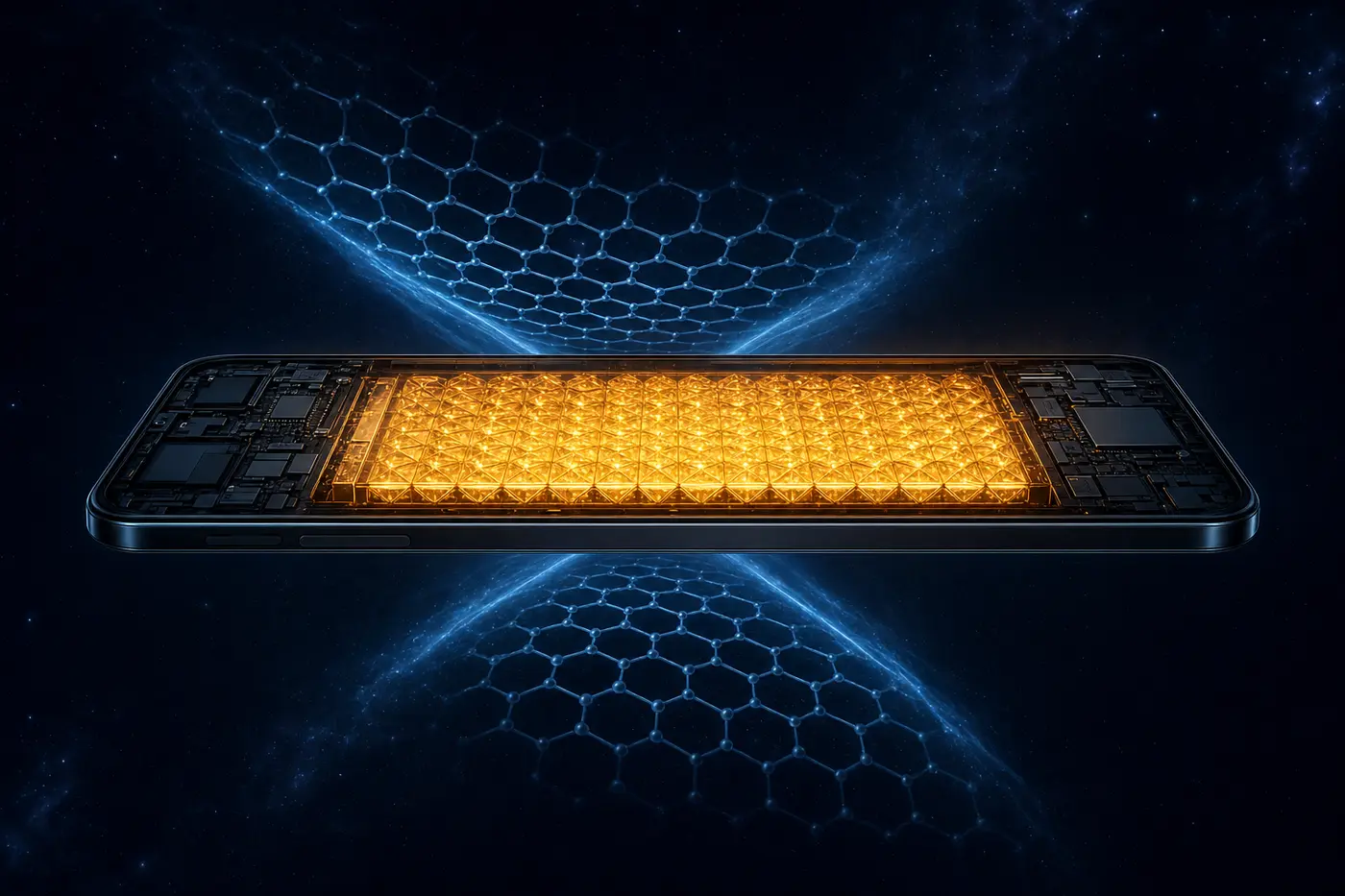
For six days straight I have written about frontier models, cryptanalysis and stolen bitcoin. Here is a deliberate palate cleanser about atoms instead of tokens — because the most consequential hardware shift of 2026 is not a chip or a model, it is an anode. Silicon-carbon batteries have quietly gone mainstream this year, and the second-order effects reach a lot further than phone spec sheets.
The headline number, stripped of marketing: Chinese flagships (Xiaomi, OPPO, vivo, HONOR, OnePlus) are now routinely shipping 6,500–7,300 mAh in the same slim chassis that held 4,500–5,000 mAh a generation ago. Honor’s Magic Win and Realme’s P4 Power have pushed a 10,001 mAh cell into an 8.3 mm frame. No new physics — just a different anode.
What actually changed
A lithium-ion cell stores charge by shuttling lithium ions into an anode. For thirty years that anode has been graphite, which holds one lithium atom per six carbon atoms — modest, but stable across thousands of cycles. Silicon holds roughly ten times more lithium per gram. The catch has always been mechanical: silicon swells when it takes on lithium, expanding up to ~300% in volume, then contracts on discharge. Pure silicon anodes crack themselves apart in a handful of cycles.
The silicon-carbon approach threads that needle. You disperse a modest fraction of silicon inside an engineered carbon matrix that absorbs the swelling — mechanically buffering the expansion while capturing most of the capacity gain. The result in shipping devices: roughly 500–600 Wh/kg versus 300–400 for conventional Li-ion, and north of 900 Wh/L volumetrically. In plain terms, 10–50% more energy in the same space, depending on how aggressively the maker dials up silicon content.
The tradeoff nobody puts on the box
That "depending on silicon content" is the entire engineering story, and it is a classic density-versus-longevity curve. More silicon means more capacity and faster degradation; the swelling stress accumulates and cycle life drops. Less silicon means a gentler curve and a smaller headline number. Every vendor is picking a point on that curve, and the point they pick is invisible to the buyer.
This matters because the failure mode is deferred, not absent. A phone that ships with a spectacular 10,000 mAh rating but an aggressive silicon fraction may sit at 80% of that capacity notably sooner than a conservative design. The industry has been here before — early fast-charging did the same thing to cycle life until conditioning and thermal management caught up. Read "silicon-carbon" as a knob, not a guarantee, and assume the aggressive configurations trade some of tomorrow’s capacity for today’s headline.
Why this is a compute story, not a phone story
Here is why a battery chemistry belongs on a blog that mostly covers AI. The binding constraint on on-device intelligence is energy per inference. Every capability we want to push to the edge — local speech, on-device vision, always-listening assistants, wearables that run models without a round trip to a datacenter — is gated by how many joules you can carry and how fast you can spend them without cooking the device. A 30–50% energy-density improvement in the same volume is not a convenience feature; it is headroom for a whole class of local workloads that were previously thermally or battery-bound.
Pair that with the other trend I keep coming back to — inference cost collapsing, small models getting genuinely capable — and the edge story sharpens. The bottleneck for "run a useful model on the thing in your pocket" has been moving from model quality to silicon efficiency to, increasingly, energy storage. Silicon-carbon just relaxed the last one. Expect the interesting edge-AI hardware of 2027 to quietly assume this density as a baseline.
The geopolitics hiding in the anode
One uncomfortable observation for Western technologists: this transition is being led almost entirely by Chinese manufacturers, with Western flagships not expected to broadly adopt until late 2026 or 2027. That is not a coincidence of marketing cadence. Silicon-carbon anode production is a materials-science and supply-chain competency — engineered carbon matrices, silicon particle sizing, electrode manufacturing at yield — and the depth of that competency now sits disproportionately in one region. The same story as the display and the modem before it: the visible brand is Western, the enabling materials science increasingly is not.
What I would take from this
- If you build edge/device products: re-baseline your power budgets. A design that assumed 2024 energy density is leaving a meaningful fraction of a battery on the table, and your competitors on Chinese hardware are not.
- If you buy devices for a fleet: treat the headline mAh with the same skepticism you apply to benchmark scores. Ask about rated cycle life to 80%, not just day-one capacity. The aggressive-silicon phone may not be the one that survives a three-year refresh cycle best.
- If you think about supply chains: add battery-anode materials to the list of quiet dependencies alongside advanced nodes and HBM. It is less discussed and no less strategic.
- The general lesson: the hyped layer (models) and the load-bearing layer (energy, memory, materials) are not the same layer. 2026’s most durable enabler might be the one that never trended.
Not everything that matters is a model release. Sometimes it is an anode that lets the model release run all day.