
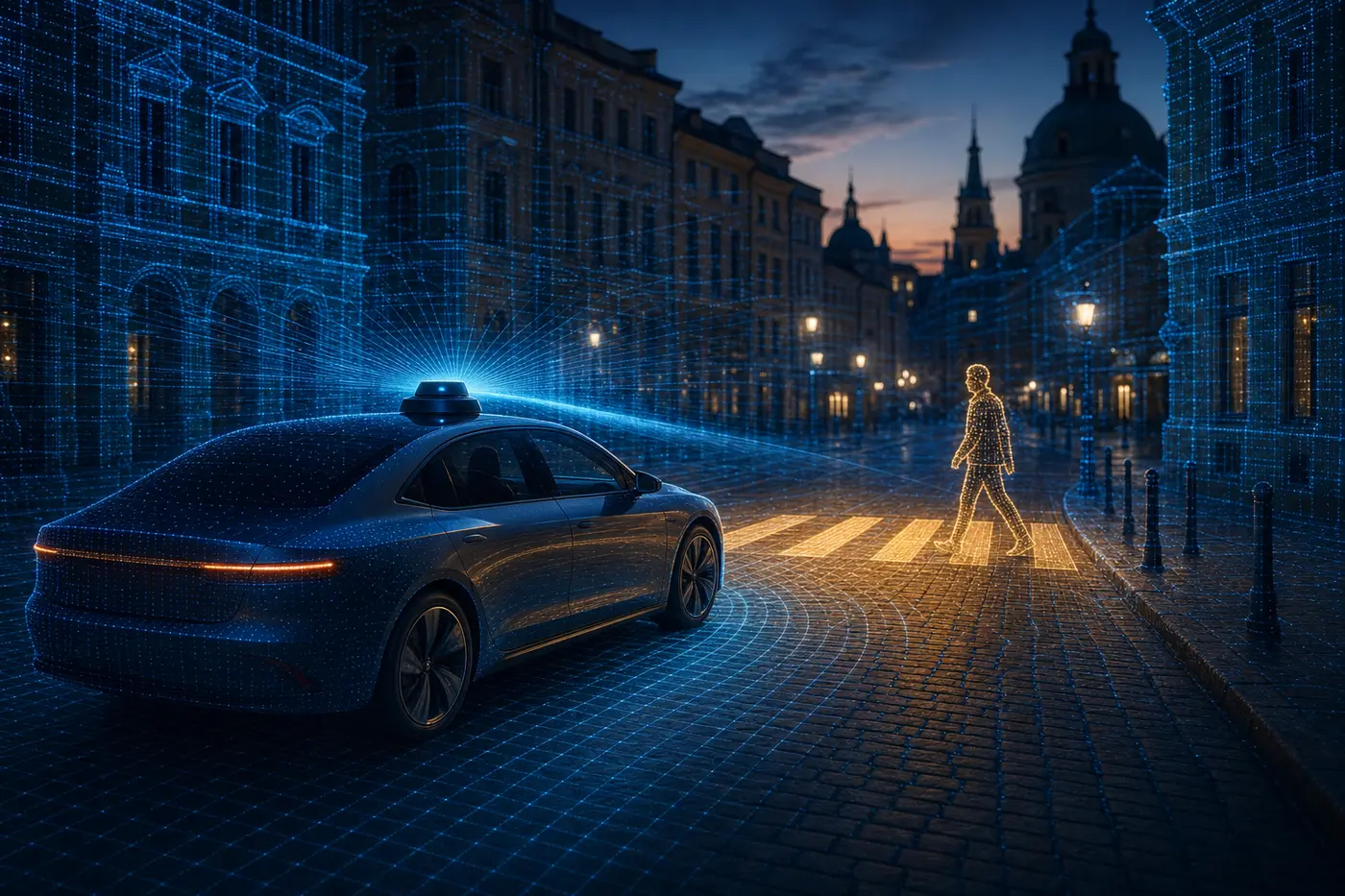
On August 14, Uber and Pony.ai announced they will deploy more than 2,000 robotaxis across five European cities — expanding from the commercial service they launched in Zagreb in March with Croatian operator Verne. It is easy to read this as one more autonomy press release. It is more interesting read as a diagram: of who owns the technology, who owns the demand, who owns the cars, and who carries the regulatory risk. In Europe in 2026, those are four different parties, and that separation is the whole story.
The stack has been unbundled
For years the implicit assumption was that whoever cracked self-driving would own the robotaxi business end to end — the Waymo model: build the autonomy, own the fleet, run the service. What is actually happening in Europe is the opposite, and it is worth naming the layers because the money and the leverage sit in different ones:
- The autonomy stack: Pony.ai — a Chinese autonomous-driving company. Also Momenta and WeRide (Chinese), and Wayve (UK/European). The hard technology.
- The demand layer: Uber. The app, the riders, the dispatch, the brand at the point of sale.
- The fleet owner/operator: local companies like Verne in Zagreb — who actually own the vehicles and run them on the ground.
- The regulator: each national and municipal authority, granting or withholding permission city by city.
This unbundling is the opposite of the vertically-integrated Waymo playbook, and it tells you Europe’s robotaxi rollout will look nothing like America’s. Nobody owns the whole thing; everybody owns a slice and depends on the others.
Why the Chinese-autonomy-into-Europe pattern matters
The under-discussed fact in the Uber–Pony.ai deal is its geopolitics. The self-driving intelligence rolling onto European cobblestones is, increasingly, Chinese. Pony.ai, Momenta, WeRide — the partners filling Uber’s European AV roster skew heavily toward Chinese firms, with Wayve as the notable European counterweight. Uber is, as one outlet put it, holding the door.
This is the same dynamic I keep flagging in other domains — open models, silicon-carbon batteries — now in physical autonomy: the visible consumer brand is Western, the enabling technology increasingly is not. But robotaxis raise the stakes, because a self-driving fleet is not a downloaded file. It is a fleet of sensors mapping European streets in high fidelity, continuously, and a control stack making real-time decisions in public space. The data-sovereignty and critical-infrastructure questions that were abstract for a chatbot are concrete for a thousand cars that see everything and can, in principle, be commanded. Expect European regulators to wake up to this framing, and expect it to become a lever — on data localization, on stack auditability, on who may operate.
The platform play is the real Uber strategy
Step back and Uber’s position is elegant to the point of being enviable. It partners with every autonomy provider — Pony.ai, Momenta, Wayve, WeRide, Nuro-Lucid — owning none of the capital-intensive, technically-brutal, regulatorily-exposed autonomy problem, while owning the one thing that is genuinely hard to replicate: aggregated demand. Whichever AV company wins, Uber is the distribution layer they must reach riders through. It is a hedge across every horse in the race, financed largely by other people’s capex.
The strategic lesson generalizes, and it is the same one from the search-and-referral piece: in a stack that unbundles, the durable position is not the hardest technical layer — it is the layer that aggregates demand and can stay neutral across suppliers. Uber learned, post-2020, that owning autonomy R&D was a money furnace. Its answer was to become the Switzerland of self-driving: partner with all, commit to none, own the rider relationship. That relationship is the moat, precisely because it is the one thing a superior autonomy stack does not automatically grant you.
The reliability question has not gone anywhere
A necessary sobering note, consistent with what I wrote about humanoid robots: deployment announcements are not deployment reality. "More than 2,000 robotaxis across five cities" is a plan, phased, with cities beyond Zagreb still undisclosed and each pending its own regulatory approval — Munich, for instance, was announced in June explicitly "pending regulatory approval," and several Uber AV launches still run with safety operators onboard. The gap between a signed partnership and a driverless car reliably handling a chaotic European old-town intersection in the rain is exactly the sim-to-real, demo-to-deployment cliff. Weight these numbers as intent, not installed base. The Zagreb service is real; the 2,000 is a roadmap.
What to watch
- Which cities, and on what regulatory terms. The undisclosed four will tell you where Europe is actually permissive. Regulatory geography, not technical readiness, is now the binding constraint on the map.
- Safety-operator status. "Robotaxi" with a safety driver onboard is a very different product — technically and economically — from genuinely driverless. Track which deployments remove the human, and when.
- The data and sovereignty debate. Watch for the first European regulator to treat a foreign-stack robotaxi fleet as a critical-infrastructure and data-sovereignty question rather than merely a transport-safety one. That reframing changes everything.
- Who blinks on capex. The fleet-owner layer (Verne-style local operators) carries the capital. If that model strains, the whole unbundled structure re-bundles — watch the balance sheets, not the ribbon-cuttings.
The robotaxi finally arriving in Europe is real news. But the more durable insight is structural: autonomy is unbundling into layers, the technology layer is increasingly Chinese, the demand layer is a neutral American aggregator, and the risk layer is a patchwork of European regulators who have not yet decided how they feel about any of it. Watch the seams between those layers. That is where the next few years of European mobility get decided — not in the demo videos.