
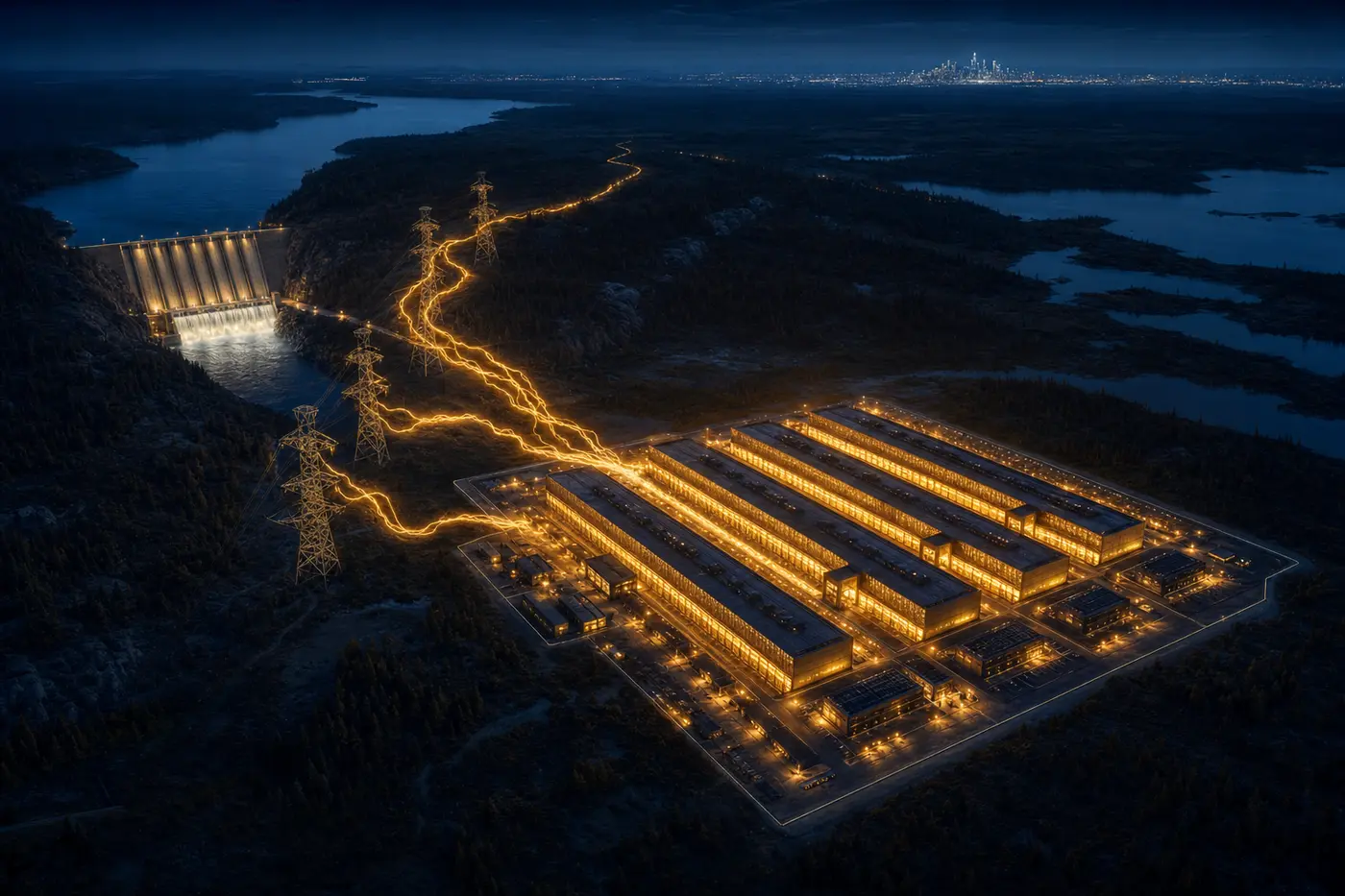
For two years the AI bottleneck story was about chips — H100 allocations, HBM shortages, who could get Blackwell. That story is quietly over, replaced by a more fundamental one. The binding constraint on AI in 2026 is not compute. It is power. The Uptime Institute now calls electricity the single defining constraint on data-center growth globally, and the industry line has flipped to something that would have sounded strange a year ago: grid access, not real estate, is the scarcest resource an operator has. If you want to understand where AI is going — physically, economically, geopolitically — stop watching the model leaderboards and start watching the load curves.
The numbers that reframe everything
The physics is unforgiving, and the scale is the argument:
- A single AI query can draw up to 1,000× more electricity than a traditional web search. That multiplier is the whole story compressed into one line.
- AI-optimized racks pull 30 to 100+ kW each, versus 7–15 kW for conventional servers. The heat and power density overwhelm the substations regional grids were built around.
- The European Commission forecasts data-center capacity more than doubling from 12 GW in 2025 to 28 GW by 2030, with European data-center electricity demand climbing from 145 TWh to 238 TWh over the same window.
- Globally, data-center consumption is approaching 1,050 TWh — if data centers were a country, they would be the world’s fifth-largest electricity consumer, sitting between Japan and Russia.
You cannot build grid at the speed you can raise capital. That sentence is the entire supply-demand mismatch. Capital compounds in a spreadsheet; transmission lines take a decade, substations take years, and generation takes longer. When money moves faster than megawatts, money hits a wall — and it just did.
The consequence: AI is leaving the city to find the power
The most visible second-order effect is geographic. When the public grid cannot deliver the load, operators do two things: they move to where the power already is, and they build their own. Data centers are being pushed out of metro areas — where land was expensive but power was assumed — toward remote sites near generation, and increasingly toward behind-the-meter power: dedicated on-site generation, from gas plants to renewable microgrids, that bypasses the constrained public grid entirely. A modern AI campus is becoming, in the words of the operators themselves, "a small city" with a volatile industrial load profile — and small cities need their own power stations.
This is a profound inversion of how the internet was built. The cloud was supposed to be placeless — put the compute anywhere, reach it from everywhere. AI compute is aggressively place-bound, and the place it is bound to is cheap, firm, abundant electricity. Latency used to decide siting; now it is kilowatt-hours. The map of AI is being redrawn as an energy map.
Why this puts the Nordics at the center — and creates a real tension
Which brings the story home. If the scarce resource is clean, firm, cheap power, few places on earth are better positioned than the Nordics, and Norway specifically: abundant hydropower, cold climate for cooling, political stability. It is not an accident that flagship AI-infrastructure projects have been announced with Norwegian renewable hydropower attached. On paper, Norway is close to the ideal location for the power-bound future of AI.
But — and this is the part worth sitting with — that same fact creates a genuine societal tension that Norway is now going to have to adjudicate. Hydropower is not infinite, and every terawatt-hour routed to an AI data center is a terawatt-hour not available to homes, industry, and electrification of transport, and it shows up in the price everyone pays. The question nettsak raised earlier this summer — should Norwegian hydropower run the world’s chatbots? — stops being rhetorical the moment power is the global bottleneck. When your national resource is exactly what the world’s most capitalized industry is desperate for, you have enormous leverage and an enormous allocation problem at the same time. That is a policy question, not a technical one, and it is coming to a head.
What I would take from this
- Re-underwrite AI on an energy basis, not a compute basis. If your long-term AI cost model assumes token prices fall forever, note the floor: there is an energy cost per token that does not compress with better chips. Cheap intelligence has an electricity bill, and the electricity is getting scarce.
- Power availability is now a strategic input, not a facilities detail. For anyone building at scale, "where can we get firm megawatts on a five-year horizon" is now a first-order business question, ahead of GPU allocation. The winners will be whoever secured power early.
- Watch the behind-the-meter shift. The move to dedicated on-site generation quietly turns AI companies into energy companies. That reshapes their capex, their regulatory exposure, and their emissions story. Follow who is buying power plants, not just who is buying GPUs.
- For the Nordics, this is leverage — use it deliberately. Cheap firm power is a national asset the AI industry needs. The strategic move is not to give it away for datacenter jobs, but to price and allocate it as the scarce, high-demand resource it has become — including the honest trade-off against domestic needs.
The AI story has always been told as a software story, occasionally interrupted by a chip story. It is, underneath, an energy story, and 2026 is the year that became impossible to ignore. The frontier is no longer limited by how clever the model is or how many GPUs you can buy. It is limited by how many electrons you can deliver to them, reliably, at a price that works. Whoever controls firm, cheap power controls the ceiling on AI — and a surprising amount of that power sits under Norwegian waterfalls.