
Here is the strangest line item in enterprise software today. The price of a fixed unit of machine intelligence — a token of a given quality — is falling faster than almost any cost curve in computing history. And yet the invoice your finance team pays for AI keeps climbing. Both things are true at once, and the space between them is the most important thing to understand if you are architecting or budgeting AI systems right now. Grasp why AI inference cost is in freefall while your bill keeps rising, and you can see where this whole market is heading.
The short version: cheap tokens do not produce small bills. They produce appetite — vast, compounding appetite. And once appetite is the thing you are managing, the real constraint stops being dollars per token and becomes something far harder to manufacture: megawatts.
Assume the frontier model you pay a premium for today is effectively free in eighteen months. Almost everything else about strategy follows from that.
LLMflation: the fastest fall in AI inference cost we have seen
Andreessen Horowitz gave the phenomenon a name that has stuck: LLMflation. For a fixed level of model quality, inference cost falls by roughly 10x every year. A GPT-3-class capability that cost about $60 per million tokens in 2021 costs around $0.06 today — a thousandfold drop in three years, steeper than the fall of compute in the PC era or of bandwidth in the dotcom build-out.
This is not one firm’s marketing chart. Epoch AI tracked the price of a given benchmark score across more than 100 models and found the cost of a fixed capability falling a median of about 50x per year, and as much as 900x on some measures. Restrict the data to 2024 onward and that median accelerates to roughly 200x per year. Pick almost any quality bar and the shape is the same — violent, sustained, and far outside the pace of Moore’s Law, which merely doubled transistor density every couple of years. Intelligence is not getting twice as cheap every two years. It is getting ten times cheaper every one.
The paradox: cheaper tokens, tripling bills
If the unit price of intelligence is collapsing, budgets should be shrinking. They are doing the opposite. Menlo Ventures put enterprise generative-AI spending at $37 billion in 2025 — 3.2 times the $11.5 billion of a year earlier — with foundation-model APIs alone accounting for $12.5 billion. The tokens got radically cheaper and the bill still tripled.
There is a 160-year-old name for this. In 1865 the economist William Stanley Jevons observed that more efficient steam engines did not cut Britain’s coal use; they raised it, because cheaper steam made steam worth burning for a hundred new purposes. Machine intelligence obeys the same law. When a capability drops a thousandfold in price you do not bank the savings — you point it at problems that were never worth the money before: every support ticket, every contract clause, every log line, every pull request. Aggregate demand overwhelms the per-unit saving many times over. The bill climbs precisely because the technology got cheap.
Why agents eat the savings
Stacked on top of Jevons is a second multiplier, and it is the defining move of this cycle: we stopped asking models for answers and started asking them to do work. A reasoning model grinding through a hard problem consumes 5 to 30 times the compute of a single-shot reply, according to EY. Wrap that reasoning in an agent — planning, tool calls, retries, sub-agents, a judge to grade the output — and the figure jumps again. EY pegs one orchestrated agentic interaction at about $1.20, against roughly $0.04 for a 2023-era chat completion. That is around 30 times more per task, in the same window the price per token fell by orders of magnitude.
This is the trap waiting for anyone modelling AI unit economics from a token price. The token got cheaper; the task got enormously larger. The billable unit quietly migrated from “a question” to “a multi-step autonomous session that runs for minutes and touches a dozen tools.” Watch only the token price and the invoice will ambush you.
The margin reckoning
This is why AI products do not behave like the SaaS businesses they are so often valued against. ICONIQ’s survey of roughly 300 software executives puts AI-product gross margins near 52% for 2026 — up from 41% in 2024, but a long way from the 75-90% traditional software enjoys. The cause is structural: a real share of cost of goods sold is now variable inference that scales with usage, and it grows as products get more capable, not less.
So pricing is being rebuilt in flight. Per-seat licensing assumes near-zero marginal cost — an assumption that dies the moment every active user is burning real tokens. The answer emerging across the industry is outcome-based pricing: charge for the resolved ticket, the closed case, the completed workflow. In ICONIQ’s data the share of AI companies pricing this way jumped to 18% from just 2% six months earlier. Intercom’s Fin, billed at $0.99 per resolved ticket, is the canonical shape. If you sell AI, the metric you charge on — token, seat, workflow, or outcome — is now a first-order strategic decision, not a billing footnote.
Who sets the floor, and who keeps the premium
The collapse is not evenly spread, and the unevenness is the whole game. In the middle of the market, the floor is set by open-weight models out of China. DeepSeek shipped V4-Pro under a permissive MIT license — 80.6 on SWE-bench Verified — and, as InfoWorld reported, permanently cut long-context inference to about a quarter of its prior pricing, with output as low as $0.87 per million tokens. Chinese labs broadly price API access 5 to 30 times below Western equivalents. When a strong, freely licensable model is that cheap, the token pricing stacked above it looks exposed — Counterpoint’s analysts said the high-margin pricing from Anthropic and OpenAI “is becoming harder to justify.”
And yet the true frontier is moving the other way. As open weights hollow out the mid-tier, the leading labs have pushed their flagship pricing up, not down: OpenAI doubled its top API rate to $5/$30 per million tokens with GPT-5.5, and Anthropic opened a tier above Opus — Claude Fable 5 — at $10/$50. That is the shape of LLM pricing in 2026: everything “good enough” racing toward the cost of electricity, while the last few points of frontier reasoning nobody else can match command a widening premium. Both moves are rational. Neither is a place to build a durable moat.
When the constraint shifts from dollars to megawatts
Follow the curve to its conclusion and something snaps. The hardware keeps delivering: NVIDIA’s Blackwell B200 reached about $0.02 per million tokens on an open model in SemiAnalysis’s InferenceMAX runs — 15 times cheaper per token than the prior generation — turning a roughly $5 million GB200 NVL72 rack into something like $75 million of token revenue over its life. The models are getting leaner too. Epoch documents a scaling reversal: once inference dominates spending, it becomes optimal to train smaller models on more data, and frontier systems shrank about 10x, from GPT-4’s estimated 1.8 trillion parameters to roughly 200 to 400 billion. Cheaper chips, smaller models, lower cost per token — the flywheel keeps turning.
But every token still costs joules, and joules do not obey Moore’s Law. The International Energy Agency projects global data-center electricity roughly doubling, from about 415 TWh in 2024 to around 945 TWh by 2030 — close to 3% of the world’s electricity — with AI accelerated servers driving nearly half of that rise. This is the hinge of the whole essay: AI inference cost per token is racing toward zero, while the trajectory of AI energy consumption compounds faster than grids can add supply. The binding constraint is migrating from the finance department to the interconnection queue — from dollars to megawatts.
The Nordic dividend, and the fight over the megawatts
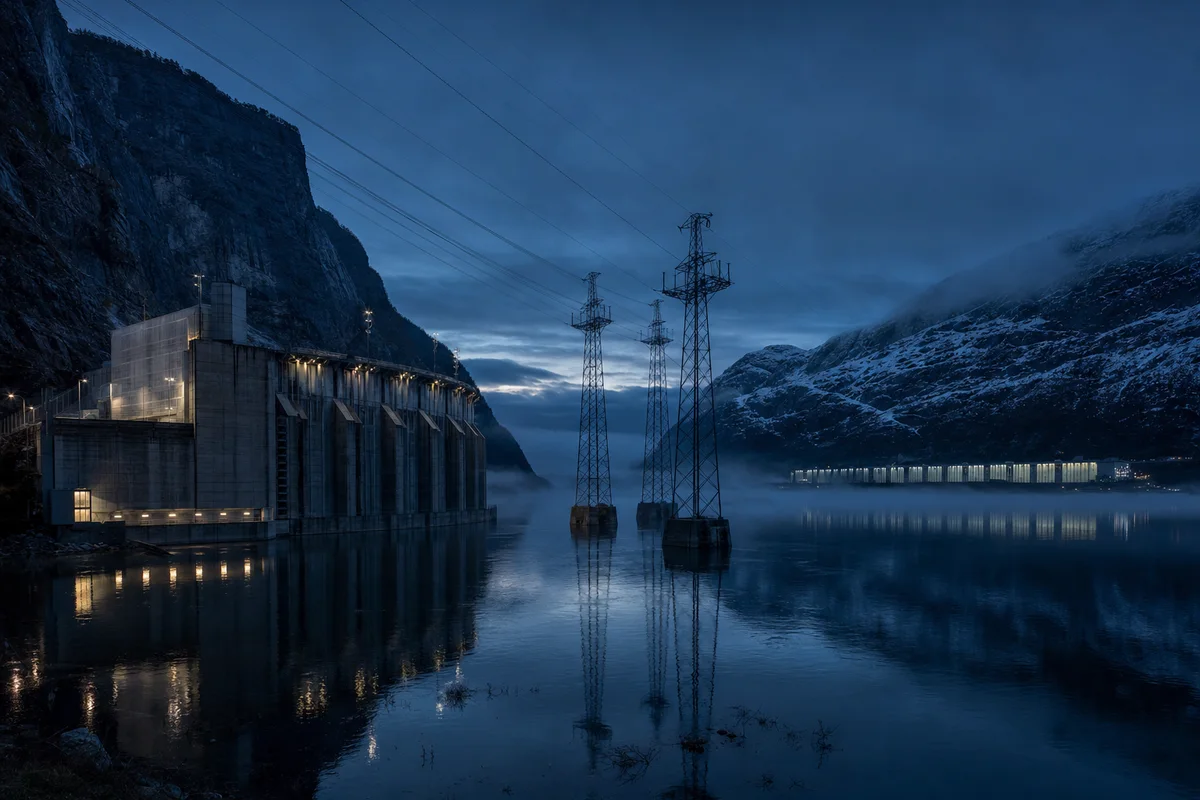
Here the map starts to matter, and I will be parochial for a paragraph, because I build from Norway. If power is the binding input, then places with abundant, cheap, low-carbon electricity and a cold climate stop being a rounding error and become a genuine moat. The hyperscalers already see it. OpenAI’s first dedicated European “Stargate” site is Stargate Norway — an Nscale/Aker joint venture at Kvandal near Narvik, targeting 100,000 NVIDIA GPUs by the end of 2026, 230MW of initial capacity with another 290MW planned, powered entirely by hydropower, with direct-to-chip liquid cooling and waste heat fed into district heating.
It is not a one-off. Nscale’s Narvik campus raised $790 million in debt from a syndicate of Nordic banks and signed Microsoft for more than 30,000 next-generation GPUs by 2027. Telenor is scaling a sovereign AI Factory in Oslo from 20 to 40MW with all customer data kept inside Norway. Denmark’s Gefion supercomputer runs 1,528 H100s for drug discovery. The Nordic pitch — clean joules, cool air, political stability, and data residency inside the EEA — is precisely the bundle a power-constrained AI industry is short of.
But here is the tension the glossy announcements skip: megawatts are allocated, not free-floating. A campus near Narvik claiming half a gigawatt is half a gigawatt that will not electrify transport, power new industry, or hold down household bills in a country where cheap electricity is treated as a birthright. Power that flows to GPUs does not flow elsewhere, and that trade-off is set to become one of the defining domestic arguments of the coming years — in Norway, and anywhere with grid headroom worth fighting over. Cheap, clean power is a moat only until the queue for it turns political.
How to build for a world where intelligence is nearly free
So what do you do with all of this? I now design every new system on a single assumption: the premium frontier model I pay up for today will be effectively free within eighteen months. That one premise reorganizes the entire strategy.
Stop competing on model access. If the model is a commodity on an eighteen-month clock, it cannot be your moat — everyone will have the same capability for pennies. What does not commoditize is your proprietary data, your evaluation harness, your workflow integration, and the hard-won context of your domain. Build the moat there, not on which API key you happen to hold.
Architect with the cost curve, not against it: route the overwhelming majority of routine calls to cheap open-weight or small specialized models, and reserve the expensive frontier for the reasoning that genuinely needs it. A system that sends every request to the most capable model available is not sophisticated — it is one whose margins get eaten alive the moment it scales.
Price on outcomes. If your own cost of goods is variable inference, per-seat billing is a slow-motion margin trap; align what you charge with what it costs to deliver. And treat power as strategy, not facilities — where your inference runs, what it costs per megawatt-hour, how clean it is, and which regulator governs the data are becoming architectural decisions, not procurement afterthoughts.
The winners of the next phase will not be the organizations with access to the best model. Everyone will have that. They will be the ones who own the data the model runs on, who price for the value it creates, and who can actually secure the electricity to run it. The price of intelligence is collapsing. Plan as if it has already hit zero — then go and find what is still scarce.